
This blog is intended for general informational purposes only and does not constitute medical advice. Every child is different and individual circumstances vary. Please consult a qualified medical practitioner about your child’s specific needs before making any healthcare decisions.
Your child is two years old and still not saying much. Maybe a handful of words, maybe none at all. Everyone around you has an opinion. Your mother says Einstein did not talk until he was four. Your neighbour says her son was the same and he is perfectly fine now. Your GP has suggested waiting a few more months.
But you are not sure. And that feeling, that quiet, persistent sense that something might be worth looking into, is worth paying attention to.
Late talking is one of the most common concerns parents bring to paediatric clinics. And one of the most common questions that comes with it is: could this be autism? The honest answer is that sometimes late talking is just that, a speech delay that resolves with time or support. But sometimes it is part of a broader picture that does warrant a closer look. Understanding the difference matters.
First, what do we mean by late talking?
A child is generally considered a late talker when their expressive language, the words they actually say, is behind where it would be expected for their age, but their social development and understanding of language appear relatively typical.
As a rough guide, toddler speech milestones generally look like this:
- 12 months: babbling, a few words like “mama” or “dada,” pointing and waving
- 18 months: around 10 to 20 words, beginning to point at things to share interest
- 2 years: around 50 words and starting to put two words together, such as “more milk” or “Daddy go”
- 3 years: sentences of three or more words, strangers able to understand most of what they say
A child who is notably behind these benchmarks, particularly at age two, is worth having assessed. That does not mean something is definitively wrong. It means that getting a professional picture is more useful than waiting and wondering.
Does every late-talking child have autism?
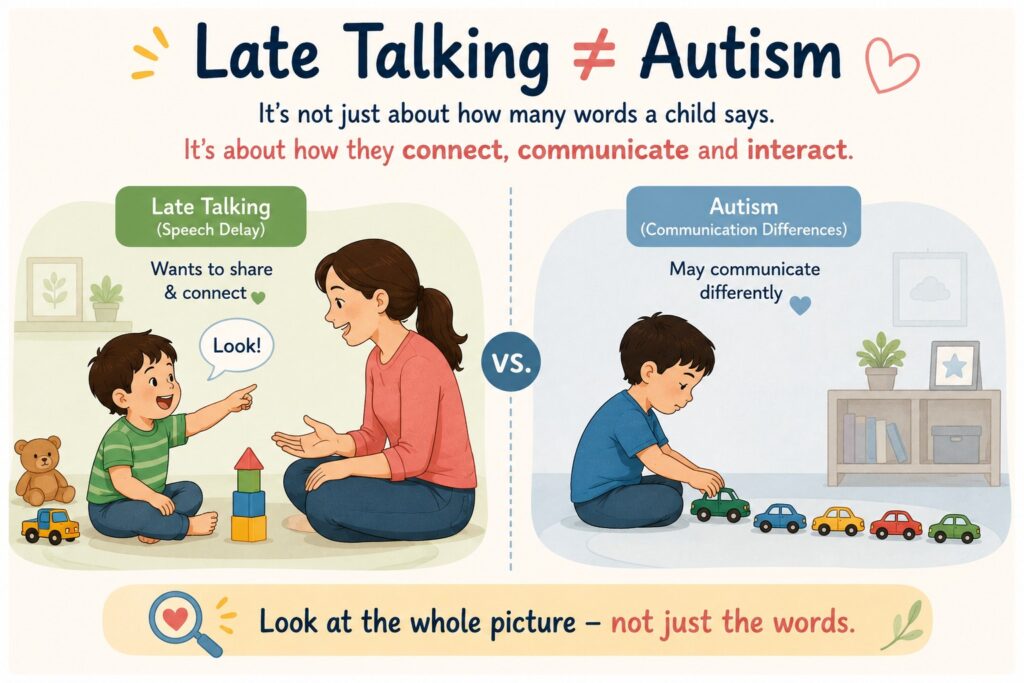
No, and this is important to say clearly. Many children who talk late have a straightforward speech delay with no autism diagnosis. Some are late talkers for reasons that have nothing to do with autism, including hearing difficulties, differences in oral motor development, being raised in a bilingual household, or simply being on the slower end of a typical developmental range.
Research suggests that a significant proportion of children identified as late talkers at age two will catch up to their peers by school age, with or without intervention (Zubrick et al., 2007). That is a reassuring statistic. But it also means that around 20 to 30 percent do not catch up on their own, and for some of those children, the language delay is part of a broader developmental profile that includes autism.
Late talking on its own is not a sign of autism. But late talking alongside other differences in social communication, play, and behaviour is something a professional should assess. The distinction lies in the whole picture, not just the words.
How can you tell the difference between a speech delay and autism?
This is the question parents ask most often, and the truthful answer is that it is not always easy to tell, particularly in very young children. Autism presentations are varied, masking can happen early, and some children do not show obvious signs until the social demands of preschool or school increase.
That said, there are some differences between a straightforward speech delay and autism communication differences that clinicians look for. The comparison below is provided as a general guide for educational purposes only and is not intended as a diagnostic tool. Only a qualified clinician can assess your individual child.
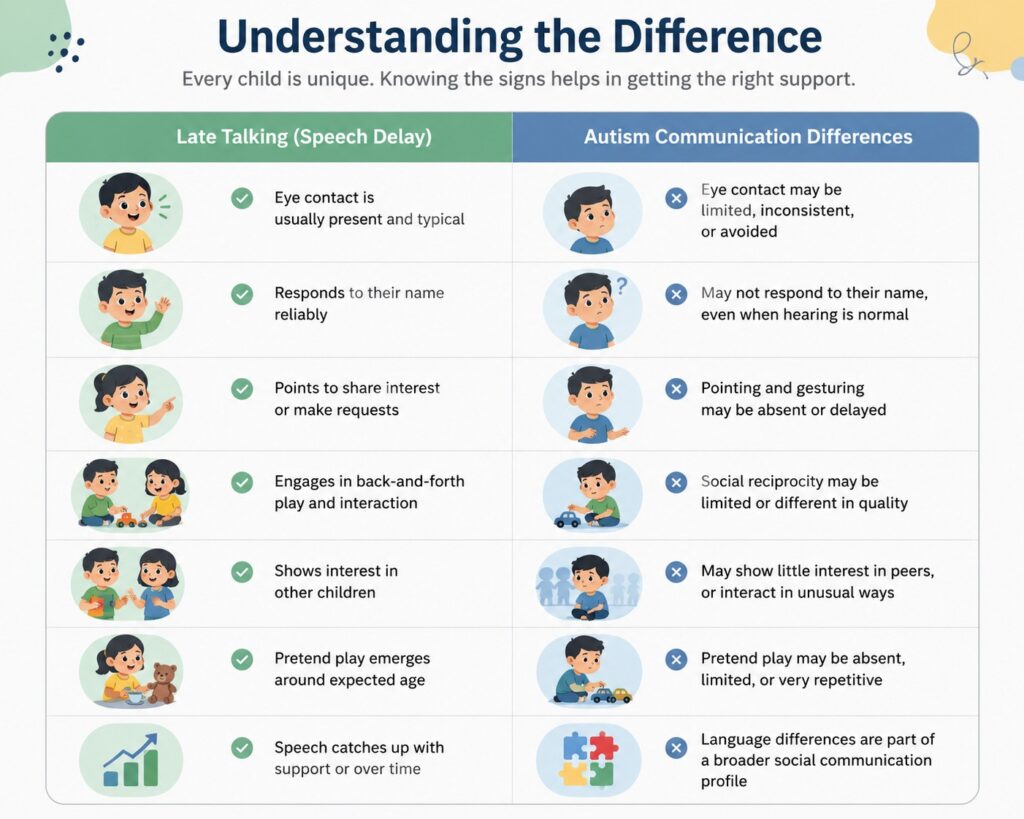
The key distinction is this: in a late-talking child without autism, the social connection is typically there. They may not have many words, but they are reaching for you, sharing their excitement about a favourite toy, pointing at the dog and looking back at you to make sure you noticed too. That social referencing, that desire to share experience, is one of the clearest early signals clinicians look for.
In autism, the differences are often in the quality of social communication rather than just the quantity of words. A child might have words, but use them in repetitive or scripted ways. They might be able to name every dinosaur but struggle to ask for help or comment on something happening around them.
What about children who had words and then lost them?
This is something to act on without waiting. If your child was developing language typically and then lost words they had previously, this regression is always worth bringing to a professional promptly. It is one of the more specific signals associated with autism, though it can also occur for other reasons. Either way, it warrants timely assessment rather than a watch-and-wait approach.
When should parents seek an autism assessment for delayed speech?
There is no single age that triggers a referral, but there are some clear indicators that a professional assessment is the right next step rather than continued waiting.
Consider seeking an autism assessment if:
- Your child has no words at 16 months
- Your child is not putting two words together by 24 months
- Your child does not point, wave, or use other gestures by 12 months
- Your child does not respond to their name consistently by 12 months
- Your child shows limited interest in other people or children
- Your child has lost language or social skills they previously had
- You are noticing repetitive behaviours, strong preference for sameness, or sensory sensitivities alongside the speech concerns
- Your instinct is telling you the picture is broader than just a speech delay
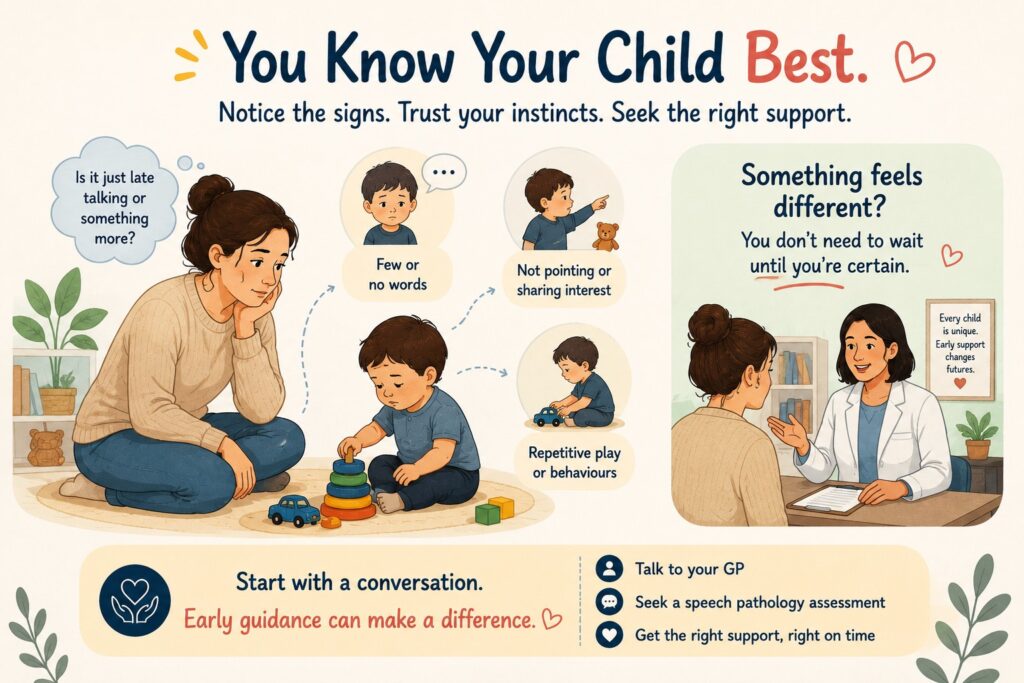
It is also worth noting that even if your child does not meet these criteria but you are concerned, seeking an assessment is always reasonable. There is no threshold of worry you need to reach before asking for a professional opinion. Earlier is nearly always better, and an assessment that finds nothing of concern is still a useful outcome.
What happens after a referral?
If your GP or child health nurse refers your child for an autism assessment, a developmental paediatrician will typically gather a detailed history, observe your child directly, and draw on input from parents, carers, and where possible the child’s early childhood setting.
Speech pathology input is often part of the process as well, since understanding the nature of the language delay, not just its severity, is important for understanding what is driving it. A speech pathologist can assess whether your child’s language difficulties are primarily expressive (getting words out), receptive (understanding language), or involve the social use of language, which points more toward an autism communication profile.
You do not need to have all the answers before you seek help. You just need to have the concern.
If you are unsure whether your child’s speech is a passing delay or something worth investigating further, a speech pathology assessment is a practical and low-barrier first step. It does not commit you to a diagnosis pathway. It gives you information.
If you have concerns about your child’s speech or communication development, start with your GP. They can discuss your observations and, where appropriate, provide a referral to a developmental paediatrician at Smart Paeds in Cockburn Central, Perth for a thorough developmental assessment.
Smart Paeds supports families across Perth with guidance, assessments, and ongoing care, working closely with parents, schools, and healthcare providers.
This blog does not replace professional medical advice. Always discuss your child’s individual circumstances with a qualified medical practitioner.
References:
- Zubrick, S.R., et al. (2007). Late language emergence at 24 months. Journal of Speech, Language, and Hearing Research, 50(6), 1562–1592.
- American Speech-Language-Hearing Association (ASHA). (2023). Late blooming or language problem? asha.org
- Autism Spectrum Australia (Aspect). (2023). Early signs of autism. autismspectrum.org.au
- World Health Organization. (2019). ICD-11: Autism Spectrum Disorder. icd.who.int
