
This blog is intended for general informational purposes only and does not constitute medical advice. Every child is different and individual circumstances vary. Please consult a qualified medical practitioner about your child’s specific needs before making any healthcare decisions.
If you have been searching “Asperger’s syndrome signs in children,” here is something to know upfront: Asperger’s is no longer a standalone diagnosis. Since 2013, it has been incorporated into the broader autism spectrum disorder (ASD) diagnosis in most clinical settings worldwide. But the profile it described – a child with strong verbal skills, high intelligence, and significant social difficulties – is very real, and many parents still use the term because it fits what they are seeing.

So rather than get lost in the terminology, here is what matters: what are the signs, and when do they warrant an assessment?
- Taking language very literally. Idioms, sarcasm, and figures of speech land flat or cause genuine confusion. “It’s raining cats and dogs” may prompt real alarm. This is not a comprehension issue – it is a difference in how language is processed.
- Deep, narrow interests. A child who knows everything about one particular topic – trains, mythology, a specific game franchise – and struggles to engage in conversations about anything else. The interest is absorbing.
- Difficulty reading social cues. Standing too close, speaking too long, not picking up when someone is bored or uncomfortable. These children are not being rude. They are often genuinely unaware of the signals most people read automatically.
- Preferring routines and struggling with transitions. A change in the usual schedule – even a minor one – can cause significant distress. Predictability feels safe; unpredictability feels threatening.
- Sensory sensitivities. Clothing tags, loud environments, certain food textures, fluorescent lighting. Sensory processing difficulties are common in autistic children and often show up early.
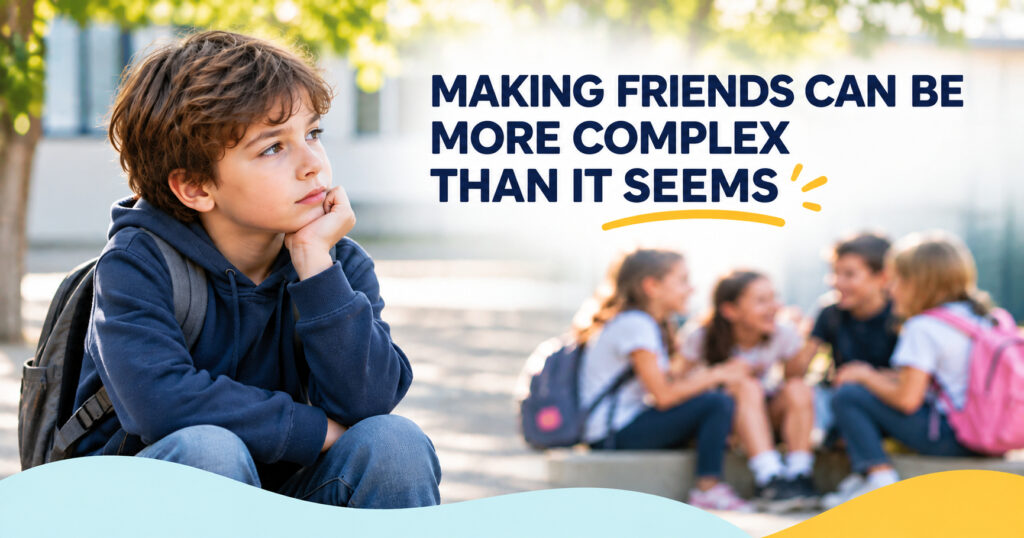
- Wanting friendships but not knowing how to build them. Many autistic children genuinely want connection. They just lack the social instincts that seem to come automatically to peers. This can lead to isolation, anxiety, and a growing sense of being different without understanding why.
- Appearing socially “off” without an obvious reason. Teachers or other parents notice something but struggle to articulate what it is. The child performs well academically but does not gel with peers. Social interactions have a slightly scripted quality.
What this often looks like at school
School tends to be where the profile becomes hardest to ignore. Many of these children are academically capable (sometimes ahead of their peers) which can actually delay concerns, because teachers and parents conflate academic ability with overall development. But capability in the classroom does not always translate to capability in the social landscape around it.
Unstructured time is often the hardest. Recess, lunch, group projects, free play – these are the moments that rely entirely on the informal social instincts that do not come naturally. A child might spend recess alone, not because they want to, but because they do not know how to enter a group already mid-conversation. They might dominate group work by trying to control the structure, because ambiguity is uncomfortable. They might have one intense friendship and struggle when that friend is absent, with no fallback.
Teachers sometimes describe these children as “a little professor” – articulate, knowledgeable, rule-conscious, but somehow out of step with the social rhythm of the classroom. That description, affectionate as it often is, is worth taking seriously.
These signs do not confirm a diagnosis. They are a starting point for a conversation. An autism assessment with a developmental paediatrician looks at the full developmental picture – communication, sensory processing, social engagement, and family history – rather than checking items off a list.
If several of these resonate, or if a teacher has raised concerns, speaking to your GP about a referral is a reasonable next step. Early support, whatever the eventual diagnosis, makes a real difference to outcomes.
You do not need to have all the answers before you make the call.
Ask your GP about a referral to the team at Smart Paeds in Cockburn Central– experienced in autism assessments and ongoing developmental support for children across Perth.
Smart Paeds supports families across Perth with guidance, assessments, and ongoing care, working closely with parents, schools, and healthcare providers.
References
1. American Psychiatric Association. (2022). Diagnostic and Statistical Manual of Mental Disorders (5th ed., text rev.). APA Publishing.
2. Attwood, T. (2006). The Complete Guide to Asperger’s Syndrome. Jessica Kingsley Publishers.
3. Marco, E.J., Hinkley, L.B.N., Hill, S.S., & Nagarajan, S.S. (2011). Sensory processing in autism: A review of neurophysiologic findings. Pediatric Research, 69(5), 48–54.
4. Howlin, P., Goode, S., Hutton, J., & Rutter, M. (2004). Adult outcome for children with autism. Journal of Child Psychology and Psychiatry, 45(2), 212–229.
