
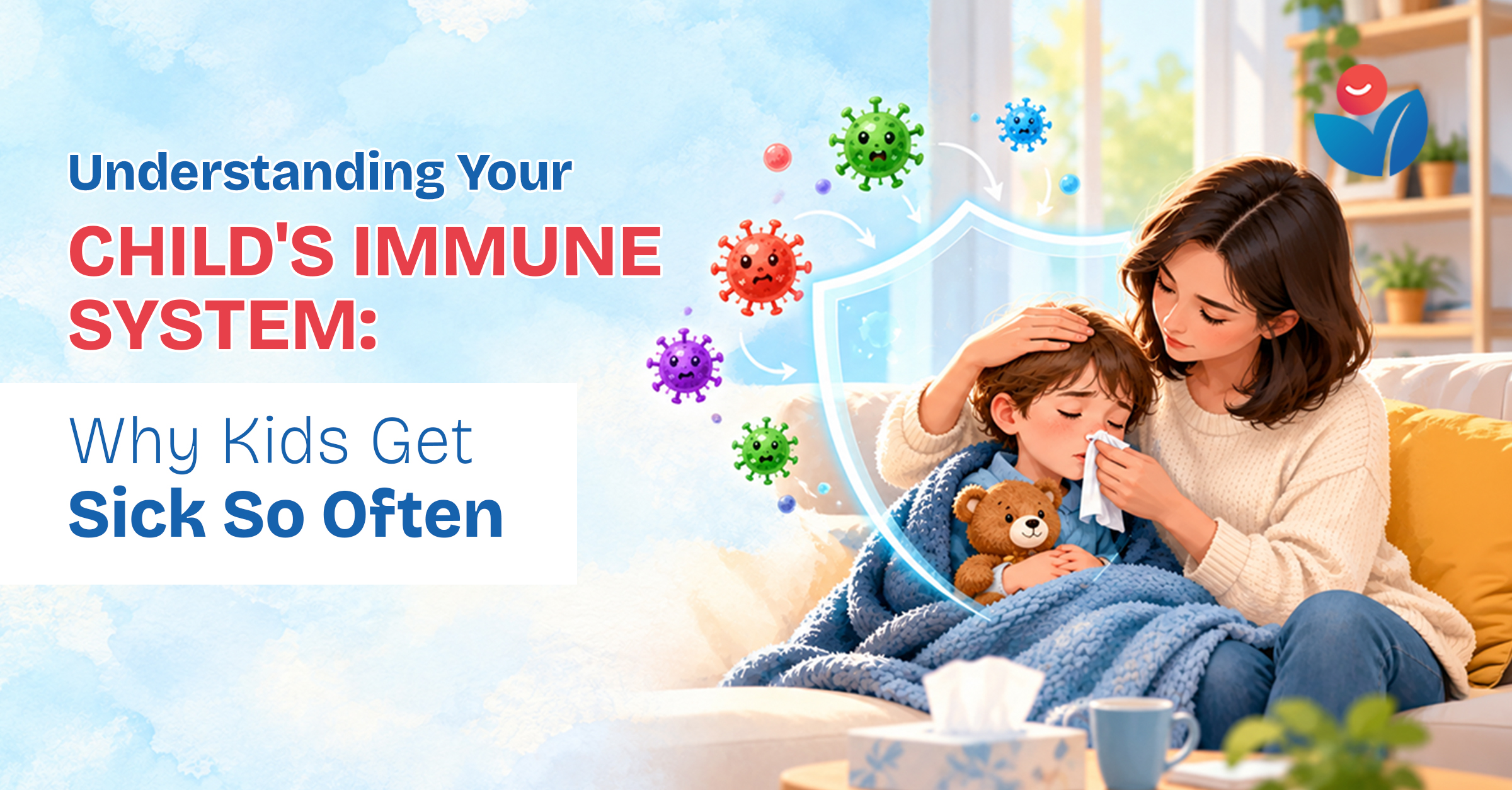
Your child started kindergarten in February. By March, you had already used up half your sick day allowance, developed a close personal relationship with your GP’s receptionist, and begun to question every life decision that led you to send a small person into a room with twenty other small people and a shared box of crayons.
Welcome to the reality of childhood immunity. It is messy, repetitive, and completely normal.
Children are, immunologically speaking, beginners
A newborn arrives in the world with some immunity borrowed from their mother, mostly through the placenta and breast milk, but their own immune system is essentially brand new and has never encountered most of the viruses and bacteria floating around in the world (Kollmann et al., 2017). Every illness is a lesson. Every runny nose is the immune system filing away information for next time.
By the time most children reach school age, they will have had between six and eight respiratory infections per year on average, and some will clock up even more in their early childcare years (Heikkinen & Järvinen, 2003). That is not a sign that something is wrong. That is the system doing exactly what it is supposed to do.
The childcare and school effect
Close contact with other children is the fastest way to accelerate immune education, which is the polite way of saying that group settings are extraordinarily efficient germ distribution networks. Children touch everything, share everything, and have not yet mastered the art of sneezing into their elbow rather than directly into someone’s face.
The upside, and there genuinely is one, is that children who attend childcare early tend to have stronger immune responses by the time they reach primary school (Caudri et al., 2009). The relentless first two years of illness often translates into fewer sick days by age six or seven. This will not make the third ear infection in a term feel any less exhausting, but it is at least something to hold onto.

When frequent illness is worth a closer look
Most childhood illness falls squarely into the “annoying but normal” category. The immune system flags concern when the pattern shifts in specific ways.
It is worth speaking with a paediatrician if your child is getting infections that are unusually severe, lasting longer than expected, or requiring repeated courses of antibiotics. Similarly, if your child is getting infections in unusual sites, such as recurrent pneumonia, repeated skin abscesses, or infections caused by organisms that rarely cause problems in healthy children, that warrants investigation (Bonilla, 2010).
Other flags include infections that do not fully clear between episodes, poor growth alongside frequent illness, or a family history of immune deficiency. These are not common, but they are important to rule out with the right assessment.
Fever: the most misunderstood symptom in paediatrics
While we are here, a word on fever. Fever is not the enemy. It is the immune system mounting a response, and in most cases it is doing its job well. The number on the thermometer matters less than how your child looks and behaves. A child with a temperature of 39 degrees who is alert, drinking fluids, and managing reasonably well is generally in a very different situation to a child who is limp, difficult to rouse, or not improving as expected (Sullivan & Farrar, 2011).
If your child has a fever and you are unsure, trust your instincts and contact your GP. Parental gut feeling has a surprisingly solid track record in paediatrics.

The things that support immunity
Sleep, good nutrition, regular physical activity, and minimising unnecessary antibiotic use are the evidence-based pillars of immune health in children (Calder et al., 2013). Supplements, unless prescribed for a specific deficiency, generally add little beyond what a reasonably varied diet provides. Hand washing, genuinely and properly done, remains one of the most effective tools available and costs nothing.
Your child will get sick. Probably a lot. And with each infection, their immune system gets a little smarter, a little faster, and a little more prepared for what comes next.
This blog is intended for general informational purposes only and does not constitute medical advice. Please consult a qualified medical practitioner about your child’s specific needs.
References
- Bonilla, F.A. (2010). Primary immunodeficiency diseases. Journal of Allergy and Clinical Immunology, 125(2), S182–S194.
- Calder, P.C., et al. (2013). Dietary factors and low-grade inflammation in relation to overweight and obesity. British Journal of Nutrition, 106(S3), S1–S78.
- Caudri, D., et al. (2009). Childhood predictors of asthma in young adulthood. European Respiratory Journal, 34(6), 1329–1337.
- Heikkinen, T., & Järvinen, A. (2003). The common cold. The Lancet, 361(9351), 51–59.
- Kollmann, T.R., et al. (2017). Innate immune function by Toll-like receptors: Distinct responses in newborns and the elderly. Immunity, 37(5), 771–783.
- Sullivan, J.E., & Farrar, H.C. (2011). Fever and antipyretic use in children. Pediatrics, 127(3), 580–587.
