

Your son is three years old. At home, he hears Mandarin (or another foreign language) from his grandparents, English from you, and a mix of both at daycare. His cousin, who grew up in a one-language household, seems to be chatting away with full sentences. Your son is quieter, slower to string words together, and now his daycare educator has mentioned she is keeping an eye on his language.
Your mind goes to the obvious question:
👉 Is raising him in two languages making things harder?
Whether the second language at home is Mandarin, Hindi, Arabic, Tagalog, or any other language, the question is the same. And it is one of the most common concerns paediatricians hear from bilingual families.
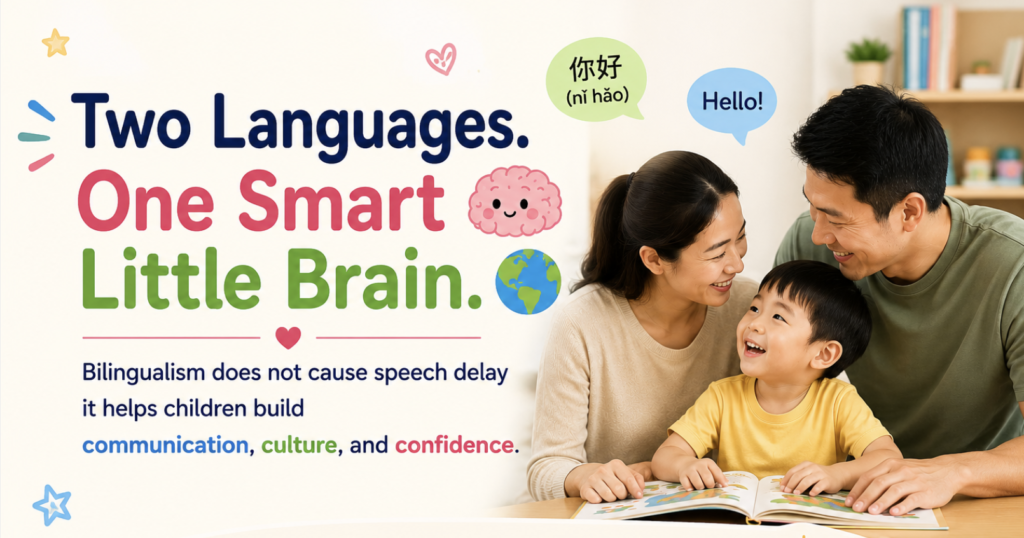
The short answer is no, bilingualism does not cause speech delays. But it is worth unpacking why that myth exists and what parents should actually be watching for.
What Is Actually Going On?
Children learning two languages at the same time are doing something genuinely complex. Their brains are sorting through:
- Two sets of sounds
- Two vocabularies
- Two grammar systems
- Different people speaking different languages
That is a significant cognitive task, and naturally, it can take a little more time.
One thing bilingual children often do early on is mix words from both languages in the same sentence. This is called code-switching. It is actually a sign that the child is drawing on everything they know to communicate. It is normal, and most children naturally sort the languages out as they get older.
Another thing worth knowing: when we count a bilingual child’s vocabulary, we sometimes look at only one language and think it is small. But if you count words across both languages together (called the conceptual vocabulary), the picture looks quite different. A child might say “water” in English and “shui” in Mandarin but not both. They know the word, just in different contexts.
What parents can look out for
While bilingualism is not a cause for concern on its own, speech development does still follow a general timeline. Some things worth paying attention to, regardless of how many languages are spoken at home:
- By 12 months, most children are babbling and using at least one or two words with meaning.
- By 18 months, they are typically using around 10 to 20 words.
- By age 2, they are usually putting two words together, even if the words come from different languages.
- By age 3, they should be understood by people outside the family most of the time, and be using short sentences.
If your child seems to understand what is said to them in either language but is not speaking much, or if they are not responding to their name, not pointing at things, or seems very limited in how they communicate overall, those are things worth raising with a professional.
What helps
The most important thing parents can do is keep talking, reading, and engaging with their child in whichever language or languages feel natural. Research strongly supports that children benefit from rich exposure to both languages, rather than being pushed toward just one.
A few practical things that tend to help:
- Reading books and telling stories in both languages exposes children to vocabulary they might not hear in everyday conversation.
- Narrating what you are doing during daily routines builds language in a low-pressure, natural way.
- Responding warmly and expansively when your child does communicate, even with a single word or a mix of languages, encourages them to keep trying.
- Avoiding pressure or correction when they mix languages keeps the experience positive.
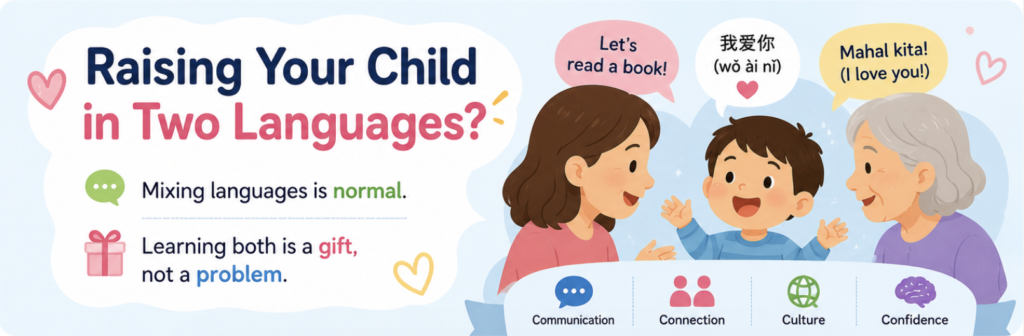
It is also worth letting both sets of caregivers, grandparents included, know that speaking their own language confidently is a gift, not a problem.
If you have concerns about your child’s speech and language development, it is always reasonable to get a professional opinion rather than waiting and wondering.
This is especially true
- if your child does not seem to understand instructions in either language,
- is hard to understand even for family members by age 3,
- stopped using words they previously had, or
- is showing other developmental differences in areas like play, social connection, or attention.
A speech pathologist with experience in bilingual children can assess across both languages and give a much clearer picture than a checklist alone. Your paediatrician can help guide you on whether a referral makes sense.
Raising a child in a bilingual home is one of the most valuable things you can offer them, not just for communication, but for connection to family, culture, and a wider world. The occasional slower stretch in spoken language is usually just the brain doing its work behind the scenes.
Trust your instincts as a parent. If something feels off, it is worth checking. If everything feels steady, keep doing what you are doing.
Smart Paeds supports families across Perth with guidance, assessments, and ongoing care, working closely with parents, schools, and healthcare providers.
