
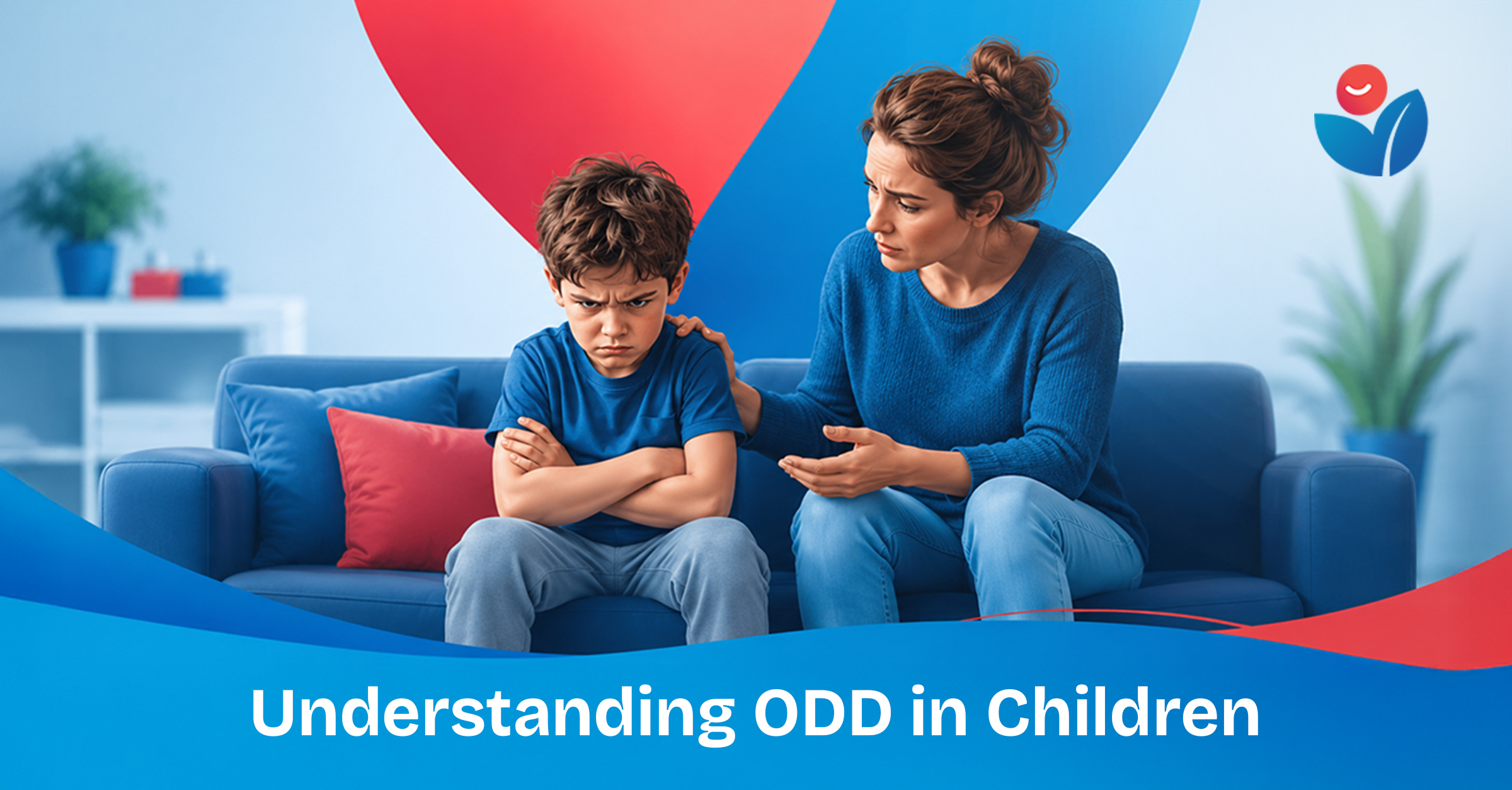
Every child pushes back sometimes. Arguing about screen time, refusing to do homework, testing boundaries at bedtime. That is normal. But for some children, the defiance is more pervasive, more intense, and more consistent than typical childhood behaviour. And for their families, daily life can feel like an exhausting negotiation that never quite resolves.
If this sounds familiar, it may be worth learning about Oppositional Defiant Disorder, or ODD, a recognised behavioural condition that affects some children and one that is far more nuanced than the name suggests.
What is ODD?
Oppositional Defiant Disorder is a pattern of angry, irritable, argumentative, or defiant behaviour that is persistent, shows up across multiple settings, and is more pronounced than what would be expected for the child’s age and developmental stage. ODD in children is not about occasional bad days or normal boundary-testing. It is a consistent pattern that causes real difficulty in the child’s relationships, at school, and at home.
ODD symptoms in kids can include frequently losing their temper, arguing persistently with adults, actively refusing reasonable requests, deliberately annoying others, blaming others for their mistakes, and being easily irritated or resentful. These behaviours need to have been present for at least six months and be causing meaningful disruption before a professional would consider an ODD diagnosis.
One thing that often confuses families is that these children can be perfectly lovely and easygoing with certain people, yet defiant and difficult with others. That inconsistency does not mean the behaviour is made up or manipulative. It is actually a recognised feature of how ODD presents.
“In plain terms, ODD describes a child who, over a long stretch of time, is often angry or irritable, regularly argues or refuses to cooperate, and can be spiteful or vengeful. We’re not talking about the occasional bad day or normal childhood pushback. ODD is a pattern that lasts at least six months and goes well beyond what you’d expect for their age. The behaviour usually shows up with people other than brothers and sisters.”
~ Smart Paeds Clinical Team
What ODD is not
ODD is not a parenting failure. It is not a character flaw in the child. And it is not simply “bad behaviour” that stricter discipline will resolve. This is one of the most important things for parents to understand, because many families come to a behavioural assessment carrying significant guilt and shame about their child’s defiant child behaviour.
ODD is a recognised disruptive behaviour disorder with neurological underpinnings. Children with ODD are not choosing to be difficult for the sake of it. Their brains process frustration, perceived injustice, and emotional regulation differently, and understanding that changes the way families can approach support.
“If your child has ODD, it is not a reflection of your parenting skills. What we see again and again is that when we manage the underlying behaviours well, the ODD symptoms improve too, and this happens while your child is living in the very same home, with the very same parents. If parenting were the cause, that simply wouldn’t happen. The home didn’t change; the support did.”
~ Smart Paeds Clinical Team
What conditions commonly appear alongside ODD?
ODD rarely appears in isolation. In most children, it sits alongside at least one other condition, and that is the real reason getting a proper assessment is so worthwhile. The overlap is significant, and based on clinical experience, the co-occurrence rates are striking:
| Co-occurring Condition | Approximate Prevalence |
| Impulse control difficulties | Up to 70% |
| Substance use (typically older children and teens) | Around 50% |
| Conduct disorder | Around 40% |
| Depression | Around 40% |
| ADHD | Around 35% |
| Intermittent explosive disorder | Around 30% |
| Social phobia | Around 30% |
| Specific phobias | Around 25% |
| Bipolar disorder | Around 20% |
| Post-traumatic stress disorder | Around 20% |
| Generalised and separation anxiety | Around 10–15% |
This is why a thorough assessment matters. When only one part of the picture is addressed, families often find that progress is slow. Understanding what else might be contributing to a child’s behaviour allows for a more targeted and effective approach to support.
“It’s also common for parents or well-meaning relatives to assume this behaviour comes down to tension or conflict in the family. But the research actually points the other way. Family conflict isn’t the driver here. The most helpful shift in thinking is this: try not to view your child’s behaviour as simply being naughty or stubborn. It’s better understood as a behavioural challenge in its own right, much like any other that deserves a proper look.”
~ Smart Paeds Clinical Team

What does support for ODD look like?
Treatment for oppositional defiant disorder typically focuses on the whole family rather than just the child. Parent management training, which helps caregivers respond to difficult behaviour in ways that reduce conflict over time, is one of the most evidence-based approaches. Depending on the child’s profile, individual therapy, school-based support, and in some cases medication for co-occurring conditions may also be part of the picture.
Parenting a child with ODD is genuinely hard, and it is important for parents to have their own support through the process as well. A good specialist will hold the whole family in mind, not just the child.
If you are concerned that your child’s behaviour goes beyond typical boundary-testing, a behavioural assessment at a clinic in Perth that specialises in these presentations can provide clarity on what is happening and what is most likely to help. Your GP can assess your concerns and refer you to a developmental paediatrician if a formal evaluation seems warranted.
Concerned about your child’s behaviour and not sure where to start? A conversation with your GP is the first step. They can talk through your concerns and, where appropriate, arrange a referral to a paediatrician or psychologist at Smart Paeds for further support, not only for your child’s wellbeing but for yours, too.
Smart Paeds supports families across Perth with guidance, assessments, and ongoing care, working closely with parents, schools, and healthcare providers.
