
This blog is intended for general informational purposes only and does not constitute medical advice. Every child is different and individual circumstances vary. Please consult a qualified medical practitioner about your child’s specific needs before making any healthcare decisions.
Pale, tired, and a bit grumpy. That describes most children on a weekday afternoon. It also describes a child who might be quietly iron deficient – and that is precisely the problem.
Iron deficiency is one of the most common nutritional deficiencies in Australian children, and one of the most underdiagnosed, partly because its early signs look so much like ordinary childhood. A simple blood test can pick it up. But first, someone has to think to ask.
The signs that tend to get missed
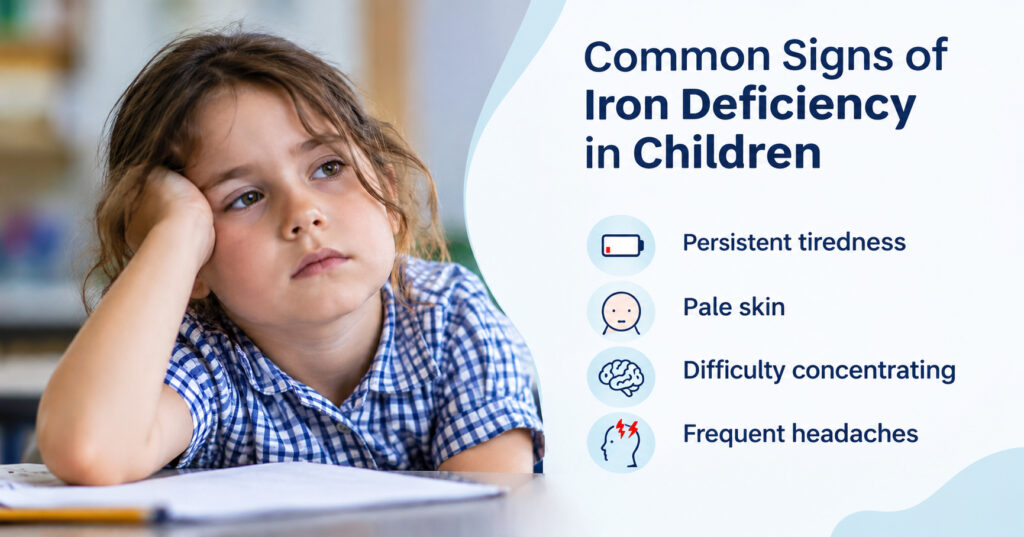
Fatigue is the obvious one, but children are not always great at articulating that they are tired. What parents notice instead is that their child seems irritable, less motivated, or harder to engage than usual. That gets filed under “phase” or “sleep” or “school stress.”
Other signs of low iron in children that are easy to attribute to something else:
- Pale skin or pale inner eyelids
- Difficulty concentrating or a shorter attention span than usual
- Frequent headaches
- Getting out of breath more easily than expected during physical activity
- An unusual craving for non-food items like ice or dirt – a condition called pica, which is a fairly specific indicator of iron deficiency anaemia
In toddlers and younger children, iron deficiency can affect brain development and has been linked to delays in cognitive and motor development if left unaddressed. This is why picking it up early matters more than parents often realise.
Who is at higher risk?
Children who drink a lot of cow’s milk (which can interfere with iron absorption in large quantities), fussy eaters with limited dietary variety, children who were premature or had low birth weight, and children on plant-based diets without careful planning around iron-rich foods are all worth keeping an eye on.
What helps iron absorption (and what gets in the way)
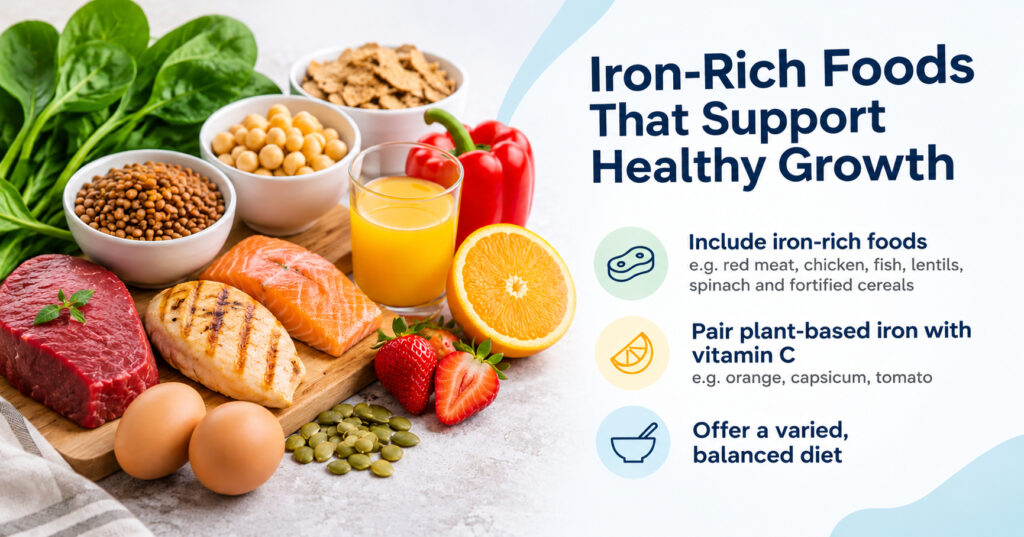
Not all iron is absorbed equally, and a few simple habits can make a meaningful difference. Haem iron, found in red meat, chicken, and fish, is absorbed much more efficiently than non-haem iron from plant sources like lentils, spinach, and fortified cereals. If your child eats mostly plant-based iron, pairing it with vitamin C, think a glass of orange juice, some tomato, or capsicum, significantly improves how much the body actually takes in
On the flip side, cow’s milk, tea, and calcium-rich foods consumed at the same time as iron-rich meals can reduce absorption. This is particularly relevant for toddlers who drink large amounts of milk throughout the day.
What happens if it goes unaddressed
In younger children the stakes are higher because iron plays a direct role in brain development during the early years. But even in older children, untreated iron deficiency has been linked to poorer concentration, lower academic performance, reduced physical stamina, and increased susceptibility to infections.
Iron deficiency in children is diagnosed with a blood test – straightforward to identify and, in most cases, straightforward to treat, usually with dietary changes and sometimes supplementation under medical guidance. The important thing is not to supplement on your own without testing first, as iron levels need to be assessed properly before treatment is started.
If several of these signs have been present for a while, it is worth raising with your GP. It may be nothing. But it is an easy thing to check, and the difference it makes when caught early is significant.
A referral from your GP to a general paediatrician at Smart Paeds can help rule out underlying causes and give you a clearer picture of your child’s overall health and development.
Smart Paeds supports families across Perth with guidance, assessments, and ongoing care, working closely with parents, schools, and healthcare providers.
References
1. Australian Institute of Health and Welfare. (2022). Australia’s Health 2022. AIHW.
2. Zimmer, K.A., Garza, C., & Dewey, K.G. (2000). Iron deficiency and pica in young children. Journal of Pediatrics, 137(1), 15–20.
3. Lozoff, B., & Georgieff, M.K. (2006). Iron deficiency and brain development. Seminars in Pediatric Neurology, 13(3), 158–165.
4. Hallberg, L., & Hultén, L. (1989). Iron absorption from the whole diet. Relation to meal composition, iron requirements and iron stores. European Journal of Clinical Nutrition, 43(6), 367–390.
5. Beard, J.L. (2001). Iron biology in immune function, muscle metabolism and neuronal functioning. Journal of Nutrition, 131(2), 568S–580S.

