
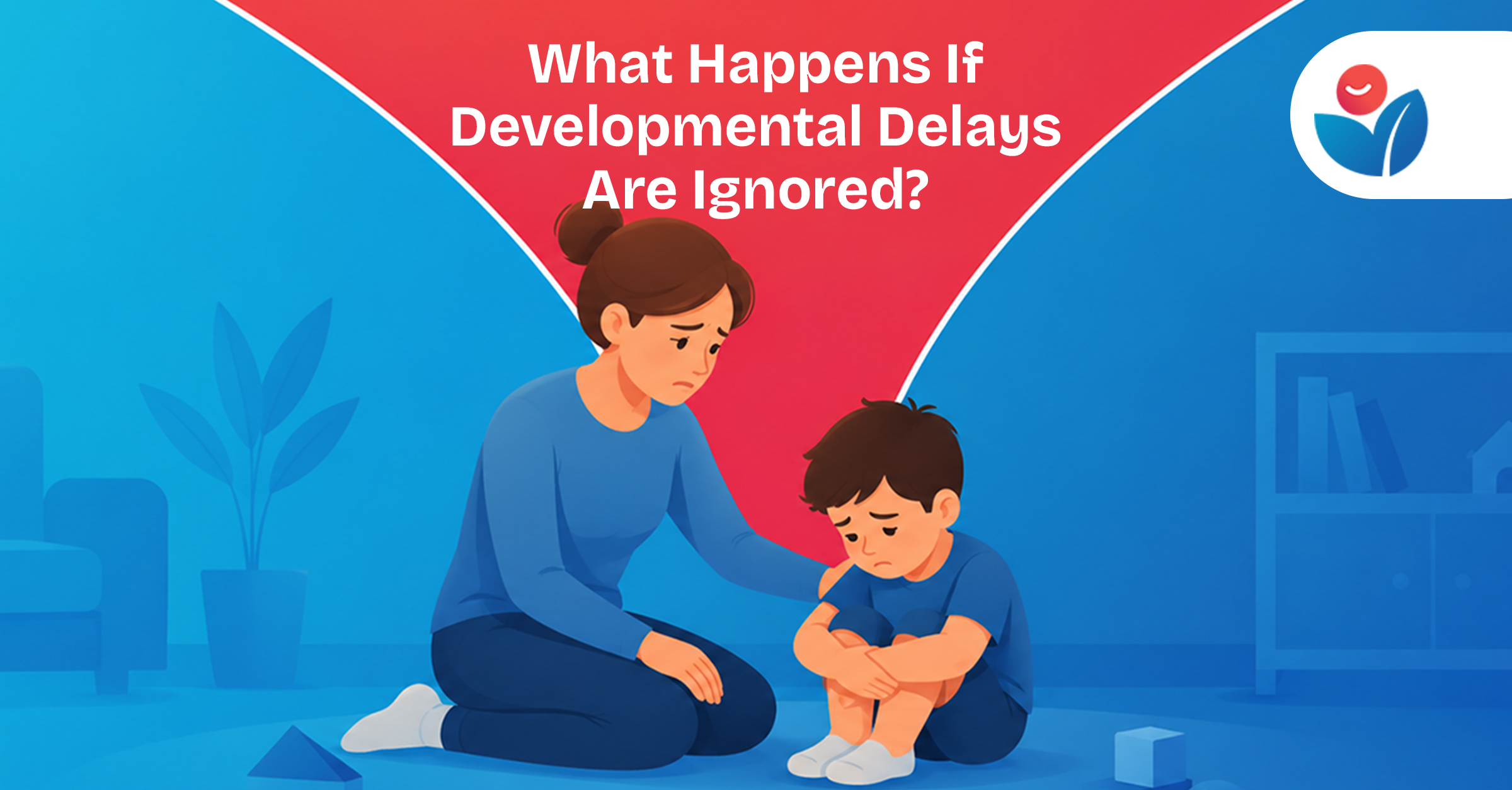
A lot of parents sit with concerns for longer than they should. Not because they do not care, but because they are hoping things will even out. Because someone told them boys are late talkers. Because their own mother said they were just like this at that age and turned out fine. Because making the appointment feels like admitting something is wrong.
That hesitation is understandable. But when it comes to developmental delays in children, time genuinely matters, and understanding what can happen when concerns go unaddressed is not about scaring parents. It is about giving them accurate information so they can make informed decisions.
What developmental delays can affect
Child developmental delay can involve any area of development: speech and language, motor skills, cognitive development, social skills, or a combination of these. Delayed milestones in children do not automatically signal a serious problem, but they are worth taking seriously because early development builds on itself.
A child who has a speech delay in their toddler years, for example, may go on to face challenges with reading and literacy at school if the underlying difficulty is not identified and supported. A child with unaddressed social communication differences may struggle with friendships, classroom participation, and self-esteem as they get older. Learning delays in children that are not picked up early can lead to a child spending years working significantly harder than their peers just to keep up, often without anyone understanding why.
“Some of the conditions behind a developmental delay are actually treatable, but only if we identify them in time. When children come in late, there’s a real risk a treatable cause has gone undiagnosed. The other loss is time itself. The early years are a powerful window, and early intervention services are genuinely effective at helping children close developmental gaps, provided there’s no underlying medical condition in the way. The later we start, the more of that window has already passed.”
~ Smart Paeds Clinical Team
The long-term effects of unaddressed developmental delays
The long-term effects of developmental delays that go without support can span several areas:
- Academic difficulties that compound over time as curriculum demands increase
- Social and emotional challenges, including difficulty forming friendships or managing peer relationships
- Reduced self-confidence, particularly in children who are aware they are struggling but do not understand why
- Secondary mental health difficulties such as anxiety or low mood
- Families and teachers who continue to manage behaviours without understanding what is driving them
Where autism and developmental delay coexist, early identification is particularly significant. The earlier a child can access appropriate support, the more it can shape their developmental trajectory in a positive direction.
Why does early intervention make such a difference?
The brain is at its most adaptable in the early years of life. Early intervention for children takes advantage of this period of neurological flexibility, when targeted support can have the greatest impact. The earlier a developmental difficulty is identified and addressed, the more opportunity there is to build skills, reduce secondary impacts, and put the right support in place before a child enters more demanding educational environments.
“In my view, early intervention is one of the most powerful things you can put in place for a child with developmental delays, and the evidence really backs this up. Services like speech and language therapy, occupational therapy, and sometimes behavioural therapy do a lot of the heavy lifting. They work with a child during the years when the brain is most adaptable, which is why starting early tends to lead to better outcomes. For children who don’t have an intellectual disability, the prognosis with this kind of support is often very encouraging.”
~ Smart Paeds Clinical Team
This is not to say that support later in childhood has no value. It absolutely does. But the evidence consistently points to early identification as having better outcomes, which is why a developmental assessment for a child should not be put off when there are genuine concerns.
What holds Perth families back from seeking help earlier ?

The barriers to seeking help are real, and worth naming honestly.
“The biggest one is simply awareness. Many parents don’t know what milestones to expect or what early signs to look for, so a delay isn’t recognised for what it is. This is especially common in culturally and linguistically diverse communities, where information may be harder to access or there can be added stigma around developmental concerns. Denial is another factor, and in my experience it often shows up more on the father’s side. Then there are the very real practical barriers. Public waitlists can be extremely long, and going private, while faster, can be expensive. These barriers are particularly relevant in Perth and across Australia.”
~ Smart Paeds Clinical Team
Understanding these barriers is not about judgment. It is about making sure families know what to do when they are ready to act, and that the path forward is clearer than it might seem.
What if you feel like you should have acted sooner?
This is something professionals hear from parents regularly, and it is worth addressing directly. Guilt about acting late is extremely common, but it is rarely as decisive as parents fear.
“If you’re carrying guilt about not seeking help earlier, the first thing worth knowing is that this feeling is completely understandable, but it’s rarely as decisive as you might fear. For a child with global developmental delay who has no underlying medical condition, the outlook is often genuinely encouraging. With allied health support and the natural boost that comes from more social interaction, such as starting school and being around other children, many of these children make meaningful progress. The delay isn’t always fixed in stone.”
~ Smart Paeds Clinical Team
The most useful thing is not to look backwards, but to focus on what can happen from here. A child developmental screening with a specialist in Perth can give you a clear picture of where things stand and what next steps make sense, without judgment about how long it took to get there.
If you have been sitting on concerns about your child’s development, now is a good time to act. Start with your GP, who can review the signs you have noticed and, if appropriate, provide a referral to a developmental paediatrician at Smart Paeds for a thorough assessment and a clear path forward.
Smart Paeds supports families across Perth with guidance, assessments, and ongoing care, working closely with parents, schools, and healthcare providers.
