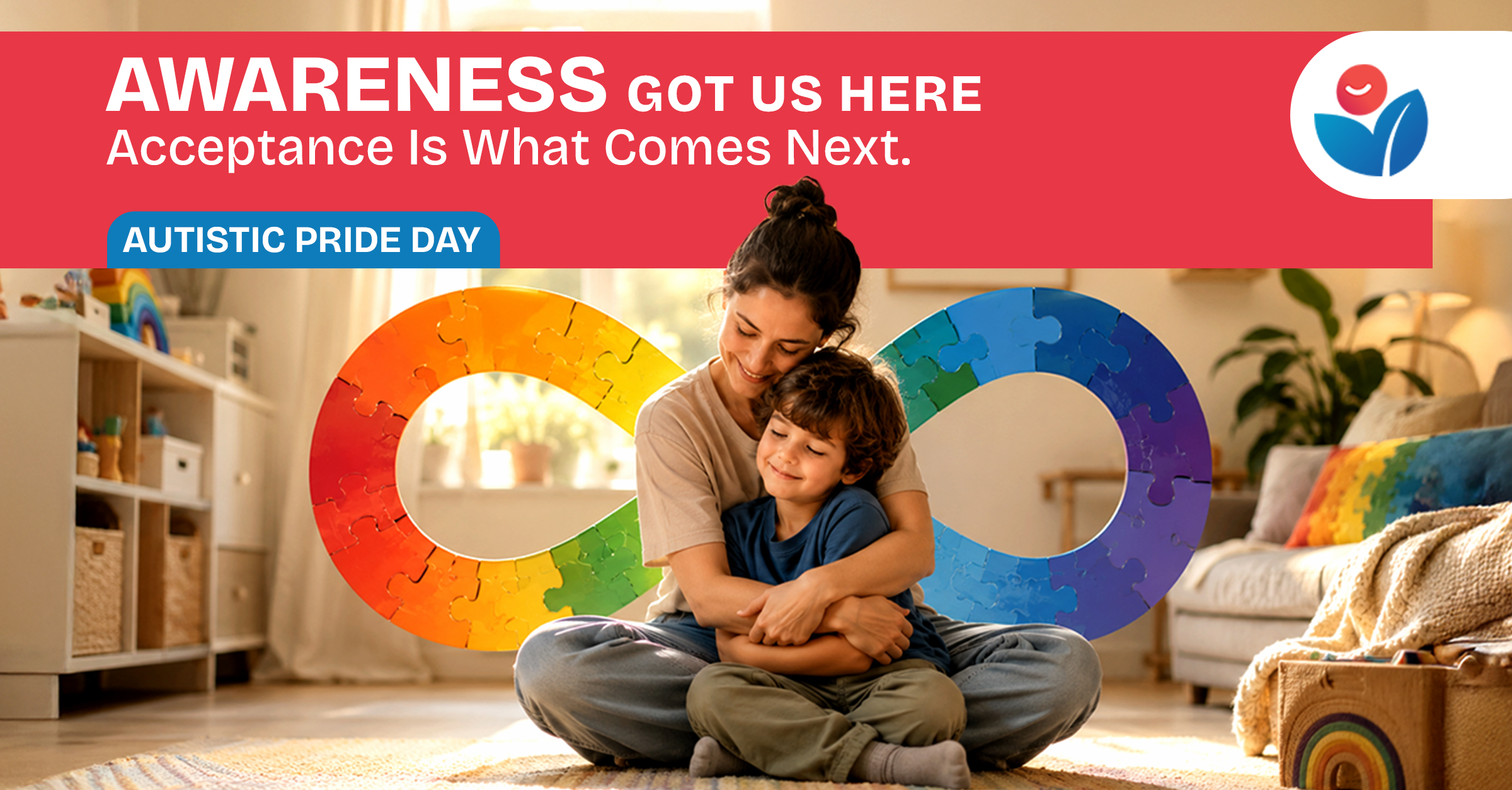
For a long time, the conversation around autism was largely about making the rest of the world aware that autistic people existed. That autism was more common than people thought. That it looked different in different people. That it was not a tragedy, not a phase, and not something caused by bad parenting.
That work mattered. Awareness opened doors. It got children assessed earlier, helped teachers recognise what they were seeing in classrooms, and gave families language for experiences they had been trying to name for years.
But awareness was always supposed to be a starting point. On Autistic Pride Day, it is worth asking sincerely:
what comes after it?
Awareness and acceptance are not the same thing
Awareness says: autism exists, and autistic people are among us.
Autism acceptance says: autistic people belong here, as they are, without needing to perform neurotypicality to earn that place.
The distinction is not semantic. Awareness can coexist with pity, with the idea that autism is something to be fixed or overcome. Acceptance cannot. Acceptance requires seeing a different neurological experience not as a deficit to be corrected, but as a genuine and valid way of being in the world.
Neurodiversity acceptance asks us to consider that the difficulties autistic people face are not always located in the person.They are often located in environments, systems, and social expectations that were not designed with them in mind.

What common misconceptions are still holding us back?
Despite how far the conversation has come, a number of misconceptions about autistic individuals remain widespread, and they have real consequences.
One of the most persistent is the idea that autism has a particular look. That autistic people are always male, always obviously different, always either non-verbal or extraordinarily gifted in one specific area. The reality of the autistic community is vastly more varied than that, and the narrow picture many people carry in their heads means countless autistic individuals, particularly women, girls, and those who have learned to mask, go unrecognised for years.
Another is the assumption that if an autistic person can manage in a given environment, they are fine.
Managing is not the same as thriving. Many autistic people are extraordinarily good at appearing to cope while carrying a significant internal load. The exhaustion of that is real, even when it is invisible.
There is also the persistent framing of autism as something that needs to be cured or grown out of. Autistic pride is, in part, a direct response to that framing. It is a clear statement from the autistic community that their neurology is not a problem to be solved.
What does autism inclusion look like?
Autism inclusion is an ongoing practice of asking: does this environment, this policy, this interaction, work for the people it is supposed to serve?
In schools, it looks like classrooms that account for sensory needs, communication differences, and varied learning styles, rather than requiring every child to engage in the same way. It looks like teachers who understand that eye contact is not a proxy for attention, and that a child who needs to move is not a child who is misbehaving.
In families, it looks like following a child’s lead. Celebrating what they love, even if it is unusual or intense.
- Understanding that a meltdown is not manipulation.
- Trusting that connection does not always look the way you expected it to.
In healthcare, it looks like professionals who listen to autistic people and their families, who do not dismiss sensory concerns or communication differences as less important than other clinical priorities, and who understand that what works for neurotypical patients may need to be adapted.

How can workplaces become more inclusive for neurodivergent individuals?
Neurodivergent inclusion in workplaces is one of the areas where the gap between stated values and lived experience tends to be widest. Many organisations say they value diversity, but have not examined whether their day-to-day environment actually supports neurodivergent employees.
Some practical shifts that make a meaningful difference:
- Clear, written communication over ambiguous verbal instructions. Many autistic employees do better with explicit expectations rather than implied ones.
- Flexibility around sensory environments. Open-plan offices with constant noise are genuinely difficult for many neurodivergent individuals. Quiet spaces, headphone policies, and flexible seating matter.
- Rethinking interview and onboarding processes. Traditional job interviews heavily favour neurotypical social performance and may not reflect the actual skills a candidate brings.
- Creating cultures where asking for adjustments does not carry stigma. If employees feel they need to mask to be accepted, inclusion has not actually happened.
The autistic community has been saying these things for years. Autistic Pride Day is a reminder that the conversation is not just for parents of autistic children, or for clinicians and educators. It is for all of us.
Celebrating autistic voices, not just autistic stories told by others
One of the most important shifts in recent years has been the growing prominence of autistic voices in conversations about autism. For a long time, the narrative was shaped almost entirely by non-autistic researchers, clinicians, and family members. The autistic community pushed back on that, and rightly so.
Celebrating autistic voices means reading and amplifying content created by autistic people. It means making space in research, policy, and practice for the lived expertise of autistic individuals. It means why autism acceptance matters is not just a question for advocates to answer. It is a question for every organisation, school, clinic, and family that intersects with the autistic community.
Awareness got us here. It was necessary, and it was not nothing. But the work of acceptance is ongoing, less visible, and far more personal. It happens in the small decisions: how we design a classroom, how we respond to a meltdown, how we talk about autism in front of autistic children who are listening.
Smart Paeds supports families across Perth with guidance, assessments, and ongoing care, working closely with parents, schools, and healthcare providers. On Autistic Pride Day and every day, we are committed to seeing and supporting each child as an individual.
