
There is a common instinct when a child does not respond to an instruction to say it again, louder, with more detail. More context, more explanation, more words. For many autistic children, this is the opposite of helpful.
Language processing in autism works differently, and understanding how changes everything about the way families and educators communicate with autistic children day to day.
How autistic children process language
Many autistic children experience what researchers describe as a longer processing time for verbal information (Millar et al., 2006). Where a neurotypical child might process an instruction within a few seconds, an autistic child may need significantly longer to decode what has been said, formulate a response, and act on it.
When more words arrive before that processing is complete, the brain has to start over. Add in background noise, sensory input, or a moment of anxiety, and the cognitive load becomes genuinely overwhelming. The child who looks like they are ignoring you may be working very hard just to catch up with the first sentence.
What “fewer words” looks like in practice
This does not mean speaking in single words or oversimplifying to the point of being unhelpful. It means being deliberate, clear, and direct. Strip an instruction down to what actually needs to be communicated.
“Can you please go upstairs and find your school bag and bring it down here and then we can leave” becomes “Get your bag. Then we go.”
The information is the same. The processing demand is completely different.
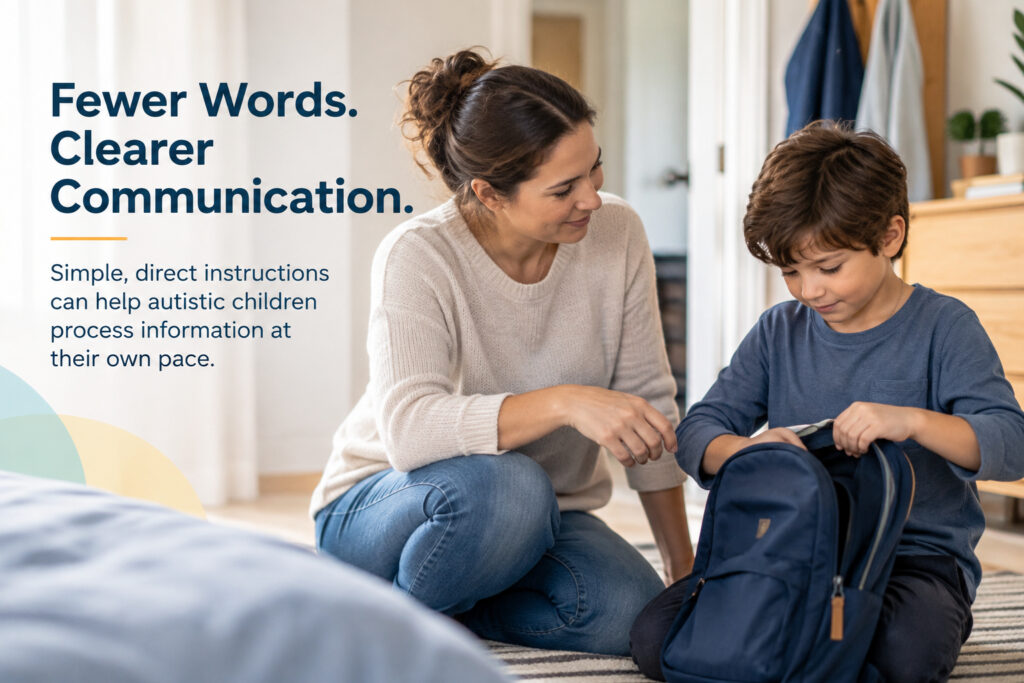
Pausing after speaking matters just as much as the words themselves. Giving a child ten to fifteen seconds of silence after an instruction, without repeating or adding more, allows the processing to happen without interruption. This is sometimes called “wait time,” and the research behind it is consistent: it significantly improves response rates and reduces anxiety in autistic children (Ingersoll & Dvortcsak, 2010).
Visual supports alongside language
Reducing verbal language works even better when paired with visual communication. A picture schedule, a written list, a simple gesture, these give the child something to reference that does not disappear the way spoken words do. For children who find auditory processing particularly difficult, visuals can become the primary communication channel while spoken language provides support around the edges (Quill, 1997).
This does not reflect a limitation. Many autistic children are strong visual thinkers, and communicating in a way that matches how their brain works tends to produce better outcomes all around.
Why parents should talk to their autistic child, not at them
Communication with autistic children is most effective when it is built around the child’s interests and initiated at a moment when they are regulated and receptive. Attempting a complex instruction during a transition, when a screen has just been turned off, or when the environment is noisy and busy, is setting everyone up for frustration.
Reading the moment matters. A child who is mid-activity, overwhelmed, or emotionally dysregulated is unlikely to process verbal information well regardless of how clearly it is delivered. Waiting for a calm moment, getting down to their level, and making gentle eye contact where comfortable for the child, changes the dynamic significantly (Prizant et al., 2006).

For families finding communication consistently difficult
Every autistic child has a different communication profile. Some children have strong verbal language but struggle with the social and processing demands around it. Others use very few words but communicate clearly through other means. Some are non-speaking and use augmentative and alternative communication (AAC) systems.
Understanding your individual child’s profile is where specialist support becomes valuable. A speech pathologist can assess how your child processes and uses language and provide strategies tailored to them. A developmental paediatrician can look at the broader picture and coordinate the right team around your family.
If communication difficulties are affecting your child’s daily life, school experience, or emotional wellbeing, your GP can provide a referral to an autism specialist at Smart Paeds in Cockburn Central, Perth.
This blog is intended for general informational purposes only and does not constitute medical advice. Please consult a qualified medical practitioner about your child’s specific needs.
References
- Ingersoll, B., & Dvortcsak, A. (2010). Teaching Social Communication to Children with Autism. Guilford Press.
- Millar, D.C., Light, J.C., & Schlosser, R.W. (2006). The impact of augmentative and alternative communication intervention on the speech production of individuals with developmental disabilities. Journal of Speech, Language, and Hearing Research, 49(2), 248–264.
- Prizant, B.M., et al. (2006). The SCERTS Model: A Comprehensive Educational Approach for Children with Autism Spectrum Disorders. Brookes Publishing.
- Quill, K.A. (1997). Instructional considerations for young children with autism. Journal of Autism and Developmental Disorders, 27(6), 697–714.
