
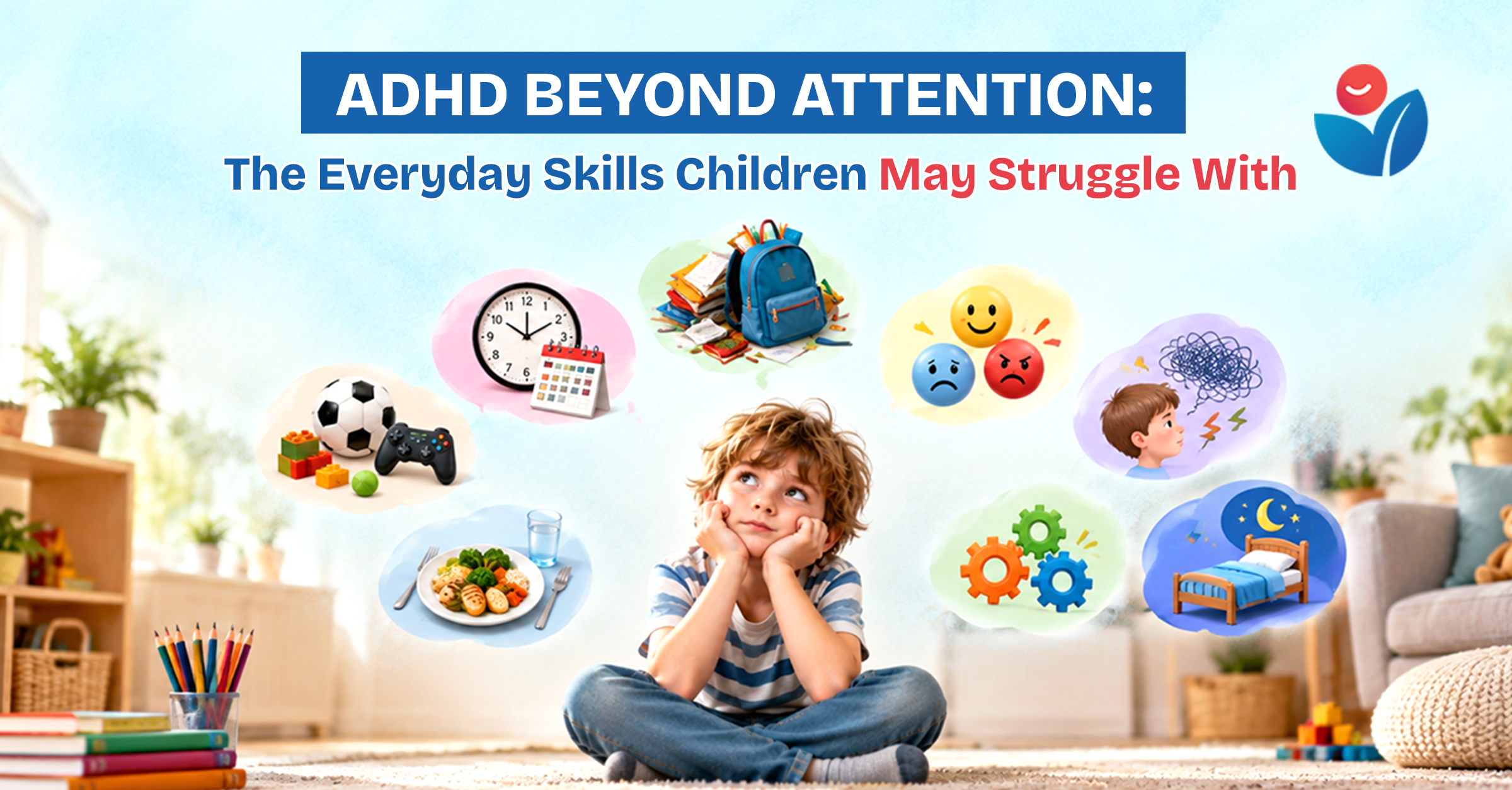
Most people think ADHD is about not paying attention. Ask any parent who has watched their child spend forty-five minutes arranging their pencil case before touching their homework, and they will tell you there is quite a bit more going on.
ADHD affects the brain’s ability to regulate, and that regulation touches almost every part of daily life. Attention is the visible tip. Underneath it sits a whole set of everyday skills that children with ADHD often find genuinely hard, and that frequently go unrecognised until a child is well into their school years.
Organisation and time management
Children with ADHD in school-aged years tend to struggle with keeping track of things, not because they are careless, but because holding multiple pieces of information in working memory while simultaneously doing something else is hard when your brain is wired this way.
- Bags get lost.
- Deadlines disappear.
- The homework that was definitely packed is somehow not there when it needs to be.
Time is its own challenge. Many children with ADHD experience time differently, where the gap between “now” and “in ten minutes” does not register the way it does for others. This is sometimes called time blindness, and it explains a lot of the apparent ignoring of warnings and countdowns that exhausts parents daily (Barkley, 2015).

Getting started and following through
Task initiation is one of the most commonly affected areas in ADHD executive function. Starting a task, particularly one that feels boring or unclear, requires a kind of mental readiness that does not always arrive on cue. Children can sit in front of an assignment they understand completely and genuinely cannot begin. This is not a motivation problem. It is a regulation one.
Finishing is equally tricky. The brain that hyperfocuses intensely on something interesting has a hard time sustaining effort through the middle stages of something less engaging. Half-finished projects are a hallmark of ADHD in children, and they can be deeply frustrating for children who wanted to finish but simply could not hold the momentum (Brown, 2013).
Emotional regulation
ADHD and emotional regulation are closely linked, and this is the area that tends to surprise families most. Children with ADHD often experience emotions with more intensity and have less time between feeling something and reacting to it. A disappointment that another child might shake off in a few minutes can spiral into a full shutdown. A minor change in plans can trigger a response that looks wildly out of proportion to the situation.
This is not drama. The same differences in the prefrontal cortex that affect attention also affect the brain’s ability to put the brakes on an emotional response (Shaw et al., 2014). Understanding this changes the way families and schools can respond, moving away from “calm down” and toward strategies that actually support the nervous system.
Social skills and reading the room
Reading social cues, knowing when to stop talking about a favourite topic, picking up on when someone has lost interest, waiting for a turn in a conversation. These are all executive skills, and they are all areas where children with ADHD can find themselves struggling without understanding why. Friendships can be harder to build and maintain, not because the child does not want connection, but because the social regulation piece is more effortful for them.

What this means for families
Recognising that ADHD affects everyday challenges well beyond attention makes it easier to meet children where they are. The child who cannot get out of the door in the morning, who forgets every instruction the moment a new thought arrives, who cries over something that seems small, is not making anyone’s life difficult on purpose. They are managing a brain that requires a different kind of support.
If these patterns sound familiar and your child has not yet been assessed, speaking with a GP about a referral to an ADHD paediatrician at Smart Paeds in Cockburn Central, Perth is a practical starting point. Assessment gives you a clearer picture of your child’s profile and opens the door to support that fits.
This blog is intended for general informational purposes only and does not constitute medical advice. Please consult a qualified medical practitioner about your child’s specific needs.
References
- Barkley, R.A. (2015). Attention-Deficit Hyperactivity Disorder: A Handbook for Diagnosis and Treatment (4th ed.). Guilford Press.
- Brown, T.E. (2013). A New Understanding of ADHD in Children and Adults. Routledge.
- Shaw, P., et al. (2014). Emotion dysregulation in ADHD. American Journal of Psychiatry, 171(3), 276–293.
