
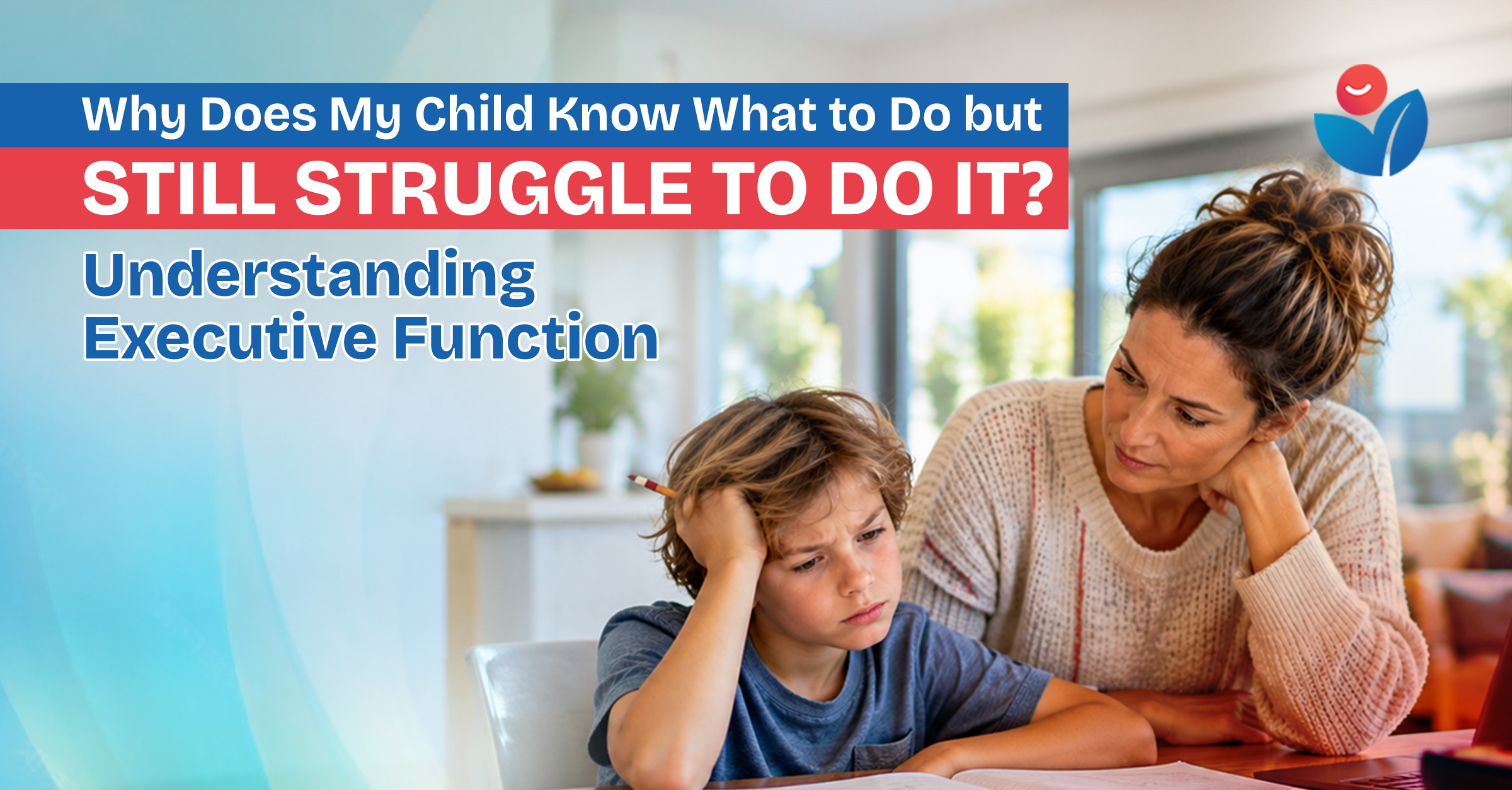
Here is something that will sound familiar. You have told your child three times to put their shoes on. They heard you. They nodded. They genuinely intend to do it. And yet, four minutes later, they are sitting on the floor arranging their shoelaces into a pattern, shoes still decidedly not on their feet.
This is not defiance. It is not laziness. And it is definitely not a hearing problem. What you are watching, in real time, is executive function doing its job poorly.
Executive function in children is one of those terms that gets thrown around a lot, especially in paediatric and school settings, without much explanation of what it means. So here it is, in plain language: executive function is the brain’s management system. It is the set of mental skills that help a person plan, start, organise, and complete tasks. It handles things like remembering what you were supposed to be doing, switching between activities without falling apart, and managing the emotional response when something does not go to plan.
Think of it as the CEO of the brain. And some children’s CEOs, frankly, are still very much in their internship.
Why knowing and doing are two completely different things
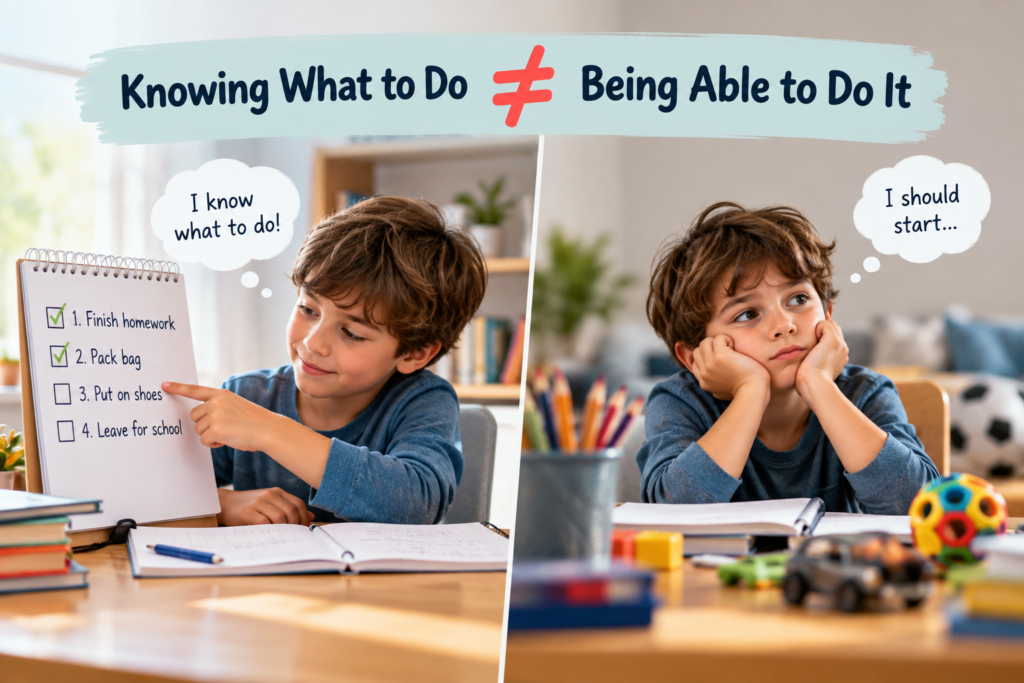
One of the most frustrating things for parents of children with executive functioning difficulties is the gap between understanding and action. Your child can tell you exactly what they are supposed to do. They can recite the steps. They can even agree that yes, they really should start their homework. And then they do not.
This happens because knowing what to do and being able to do it are handled by different parts of the brain. Executive function skills in children sit largely in the prefrontal cortex, which is also the last part of the brain to fully develop. In fact, it keeps maturing well into a person’s mid-twenties (Gogtay et al., 2004). So when your eight-year-old cannot seem to get started on a task they clearly understand, their brain still very much under construction.
For children with ADHD and executive function difficulties specifically, this gap tends to be wider and more persistent. Research consistently shows that children with ADHD can have an executive function profile that is two to three years behind their peers, meaning a ten-year-old with ADHD may be operating more like a seven or eight-year-old in this area (Barkley, 2012). It is context. And context changes everything about how you respond.
What executive dysfunction looks like day to day
Executive dysfunction in children rarely looks like what people expect. It does not usually present as a child sitting still, staring blankly, clearly struggling. It tends to look more like:
- A child who loses their belongings constantly, not because they do not care, but because holding information in working memory while also doing something else is genuinely hard for them.
- A child who starts strong and then abandons a task halfway through, not out of laziness, but because sustaining effort over time is one of the executive function skills they find most difficult.
- A child who explodes over something small because they have already used up their entire regulation budget getting through the school day.
- A child who is highly capable and clearly intelligent, but cannot seem to get out of the door in the morning without a fifteen-step intervention from at least one parent.
Sound familiar?
Why does my child understand instructions but struggle to follow them?
This is the question parents ask most often, and it deserves a direct answer. Understanding an instruction and executing it are two separate cognitive processes. Comprehension happens in one part of the brain. The actual initiation of action, holding the goal in mind while completing it, and staying on track despite distractions, those happen in the prefrontal cortex, the very area where executive function lives.
For a child with executive functioning difficulties, the message gets received but somewhere between reception and action, the signal gets lost. It is a bit like having excellent Wi-Fi but the device keeps dropping the connection before the page loads. The internet is there. The device knows what it is supposed to do. The loading just does not happen.
How can I help my child improve executive function skills?
The most important thing to understand here is that you cannot lecture or discipline executive function into a child. Consequences and reminders do not build the underlying skill. What does help is environmental scaffolding, which is a fancy way of saying: set up the world around them to do some of the work their brain is not yet doing reliably.

Some approaches that tend to support children with executive function challenges include:
Breaking tasks into the smallest possible steps and presenting one step at a time rather than a full list. Visual schedules and checklists that externalise the plan so the child does not have to hold it all in their head. Consistent routines that reduce the number of decisions that need to be made each day. Transition warnings before an activity ends, because shifting between tasks is one of the hardest things for many of these children. Working alongside them rather than monitoring from a distance, at least until the skill starts to build.
It is also worth noting that helping children with executive function is not a quick fix. It is a long game. The goal is to gradually transfer the external scaffolding into internal skills over time, which is exactly what good occupational therapy and paediatric support is designed to do (Diamond, 2013).
If you are finding that your child’s difficulties with planning, starting, or completing tasks are affecting their daily life, their schooling, or their sense of themselves, it is worth having a conversation with a professional. A child development specialist can help you understand what is driving the difficulties and what support is most likely to help.
Your GP can provide a referral to a developmental paediatrician at Smart Paeds in Cockburn Central, Perth, where your child’s individual profile can be assessed and a plan put together that fits your child.
This blog is intended for general informational purposes only and does not constitute medical advice. Every child is different and individual circumstances vary. Please consult a qualified medical practitioner about your child’s specific needs before making any healthcare decisions.
References
- Barkley, R.A. (2012). Executive Functions: What They Are, How They Work, and Why They Evolved. Guilford Press.
- Diamond, A. (2013). Executive Functions. Annual Review of Psychology, 64, 135–168.
- Gogtay, N., et al. (2004). Dynamic mapping of human cortical development during childhood through early adulthood. PNAS, 101(21), 8174–8179.
